
Engineering articlesPlaster quantity calculation: area, cement, sand and deductions
How to measure plaster, when to deduct openings, and how much cement and sand 12 mm and 20 mm plaster needs in 1:4 and 1:6 mortar, with a worked example for one room.
By Muhammad Sarowar Hossain, Founder & CEOPublished 15 October 2026Updated 24 November 20266 min read
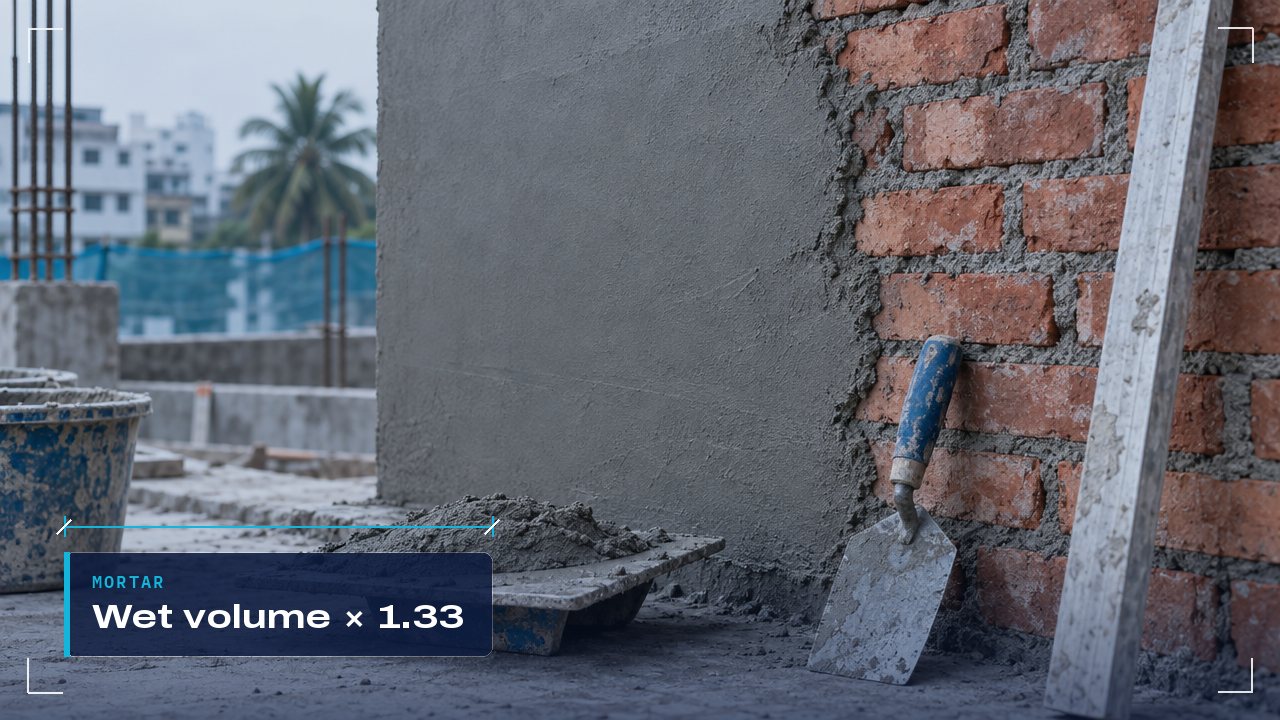
Plaster is measured by area and bought by volume. The BOQ carries square feet or square metres; the cement and sand depend on the thickness and the mix. Keep the two steps apart and the estimate is easy to check.
Measuring the area
- Measure every face separately: the inside and the outside of an external wall, and both faces of an internal wall.
- Ceilings and the undersides of beams are usually separate items, because the thickness and the rate are different.
- Use the clear height from floor to ceiling for inside walls, and the full height including the parapet for outside walls.
100 sft of 12 mm plaster
4.17 cft
100 × 0.5 ÷ 12.
Deducting openings
The method of measurement you work to sets the rule. A common one is this: small openings, up to about 0.5 sqm (5 sft), are not deducted and their edges are not added; larger openings are deducted, and their returns (the jambs, sill and soffit that are plastered inside the opening) are measured and added.
Whichever rule you use, write it on the estimate. Two people using two rules will never agree on the area of the same room.
From area to mortar
Wet mortar = area × thickness. Cement and sand are bought dry, so multiply by 1.33 for dry volume. On rough brickwork, mortar is also lost in filling joints and hollows, and some falls. Many engineers allow about 20% for that, which makes the whole factor about 1.6 over the wet volume.
For 100 sft of 12 mm (½ inch) plaster:
- Wet volume = 100 × 0.5 ÷ 12 = 4.17 cft
- Dry volume = 4.17 × 1.33 × 1.2 = 6.65 cft
| Mortar | Parts | Cement | Sand |
|---|---|---|---|
| 1:4 | 5 | 6.65 ÷ 5 = 1.33 cft = 1.06 bags | 5.32 cft |
| 1:6 | 7 | 6.65 ÷ 7 = 0.95 cft = 0.76 bag | 5.70 cft |
In metric units, 1 sqm of 12 mm plaster in 1:4 takes about 0.019 cum of dry mortar: roughly 0.11 bag of cement and 0.015 cum of sand.
Usual thicknesses
| Where | Usual thickness |
|---|---|
| Inside walls | 12 mm |
| Outside walls | 16 to 20 mm |
| Ceilings | 6 to 10 mm |
Follow your specification where it says otherwise. A wall that is out of plumb takes more than its nominal thickness, and that extra is paid for by whoever built the wall badly.
A worked example
A room 14 ft × 12 ft with walls 10 ft high, one door of 3' × 7' and one window of 5' × 4'.
- Walls = 2 × (14 + 12) × 10 = 520 sft
- Deduct the door, 21 sft, and the window, 20 sft: 479 sft
- Wet volume at 12 mm = 479 × 0.5 ÷ 12 = 19.96 cft; dry = 19.96 × 1.6 = 31.9 cft
- In 1:4: cement = 31.9 ÷ 5 = 6.4 cft = 5.1 bags, sand = 25.5 cft
- The ceiling, 14 × 12 = 168 sft, is a separate item.
Mistakes we see often
- Only one face of a wall measured.
- Openings deducted but the returns forgotten, or the returns added without the deduction.
- Outside plaster measured at the inside height, without the parapet.
- Wet volume used to order materials.
Quick reference for 100 sft of plaster
The same arithmetic as above, for the three thicknesses used most. Dry volume is the wet volume × 1.33 × 1.2.
| Thickness | Wet volume | Dry volume | 1:4 cement | 1:4 sand | 1:6 cement | 1:6 sand |
|---|---|---|---|---|---|---|
| ¼ inch (6 mm) | 2.08 cft | 3.33 cft | 0.53 bag | 2.66 cft | 0.38 bag | 2.85 cft |
| ½ inch (12 mm) | 4.17 cft | 6.65 cft | 1.06 bags | 5.32 cft | 0.76 bag | 5.70 cft |
| ¾ inch (20 mm) | 6.25 cft | 9.97 cft | 1.60 bags | 7.98 cft | 1.14 bags | 8.55 cft |
Cement and sand rise in step with the thickness. Plaster that is laid ¾ inch thick where ½ inch was priced uses half as much material again.
A worked example: the ceiling of the same room
The ceiling of the room above is 14 ft × 12 ft = 168 sft, plastered ¼ inch thick in 1:4.
- Wet volume = 168 × 0.25 ÷ 12 = 3.5 cft
- Dry volume = 3.5 × 1.33 × 1.2 = 5.59 cft
- Cement = 5.59 ÷ 5 = 1.12 cft = 0.9 bag
- Sand = 5.59 × 4 ÷ 5 = 4.5 cft
A worked example: an outside wall with its parapet
An outside wall 40 ft long, with a 10 ft storey height and a 3 ft parapet above it, plastered ¾ inch thick in 1:4 on the outside face.
- Area = 40 × (10 + 3) = 520 sft
- Wet volume = 520 × 0.75 ÷ 12 = 32.5 cft
- Dry volume = 32.5 × 1.33 × 1.2 = 51.9 cft
- Cement = 51.9 ÷ 5 = 10.4 cft = 8.3 bags
- Sand = 51.9 × 4 ÷ 5 = 41.5 cft
The inside face and the top of the parapet are plastered too. Measure them as their own lines; they are the faces most often left out.
Measuring the returns of an opening
When an opening is deducted, the plastered faces inside it are added. For the window of 5' × 4' in the room above, set in a 10 inch wall with 5 inches of return plastered on the inside:
- Length of the returns = 2 × (5 + 4) = 18 ft
- Area = 18 × 5 ÷ 12 = 7.5 sft
So the window takes 20 sft out of the wall and gives 7.5 sft back. The net area of the room becomes 479 + 7.5 = 486.5 sft, if the door has no plastered return.
Checks on site
- Check the thickness before the wall is covered. Level pads or screed strips fixed first show how thick the coat will really be.
- Check the wall, not only the plaster. Hold a straight edge against the brickwork. A hollow of half an inch doubles the mortar on that patch.
- Count the bags per day against the area finished. At ½ inch in 1:4, 100 sft should take about one bag.
- Cure for seven days, and keep new plaster out of direct sun and wind while it sets.
Questions people ask
How much plaster does one bag of cement cover? From the table: at ½ inch in 1:4, about 94 sft (100 ÷ 1.06). At ½ inch in 1:6, about 130 sft. At ¾ inch in 1:4, about 62 sft.
Is the allowance of 1.2 always right? No. It is a working figure for ordinary brick walls. A true, well-built wall takes less and a rough or out-of-plumb wall takes more. Use your own figure if you have measured it, and write it down.
Are both faces of a wall one item? They can be, if the thickness and the mix are the same. Outside plaster is normally thicker, so it is its own item.
Is a rough first coat measured separately? Only if the specification prices it separately. Otherwise the item is the finished plaster of the stated total thickness.
In Estimatrix
An area item on the measurement sheet asks only for number, length and width. Enter each opening as a deduction row. A second coat, or the paint that follows, can be linked to the plaster rows with linked measurements, so the areas always match. For the price side, see rate analysis of plaster, or try the plaster calculator.
- 92.90 sqm × 0.012 m
- 1.115 cum wet
- × 1.33 for dry mortar
- 1.483 cum
- Cement, 1 part in 5
- 8.5 bags
- Sand
- 1.19 cum (42 cft)
Uneven walls take more. Add your site wastage.
#plaster#finishing#mortar
Related articles
What is a bill of quantities (BOQ)? A practical guide for Bangladesh
What a BOQ is, what each column means, how it is measured and priced, and the mistakes that cost money, explained with a small worked example.
30 Oct 2026 · 7 min readRead
Construction cost per square foot in Bangladesh (2026): rates, adjustments and checks
What a building costs per square foot in Bangladesh in 2026 for apartments, offices, factories, hospitals and steel sheds, what moves the figure, and how to use it to check a BOQ.
28 Oct 2026 · 6 min readRead
PWD Schedule of Rates explained: editions, zones and how to use them
What the PWD Schedule of Rates is, how its four schedules, four zones and editions work, what a schedule rate includes, and how to read an item correctly.
27 Oct 2026 · 6 min readRead