
Engineering articlesWhat is a bill of quantities (BOQ)? A practical guide for Bangladesh
What a BOQ is, what each column means, how it is measured and priced, and the mistakes that cost money, explained with a small worked example.
By Muhammad Sarowar Hossain, Founder & CEOPublished 30 October 2026Updated 24 November 20267 min read
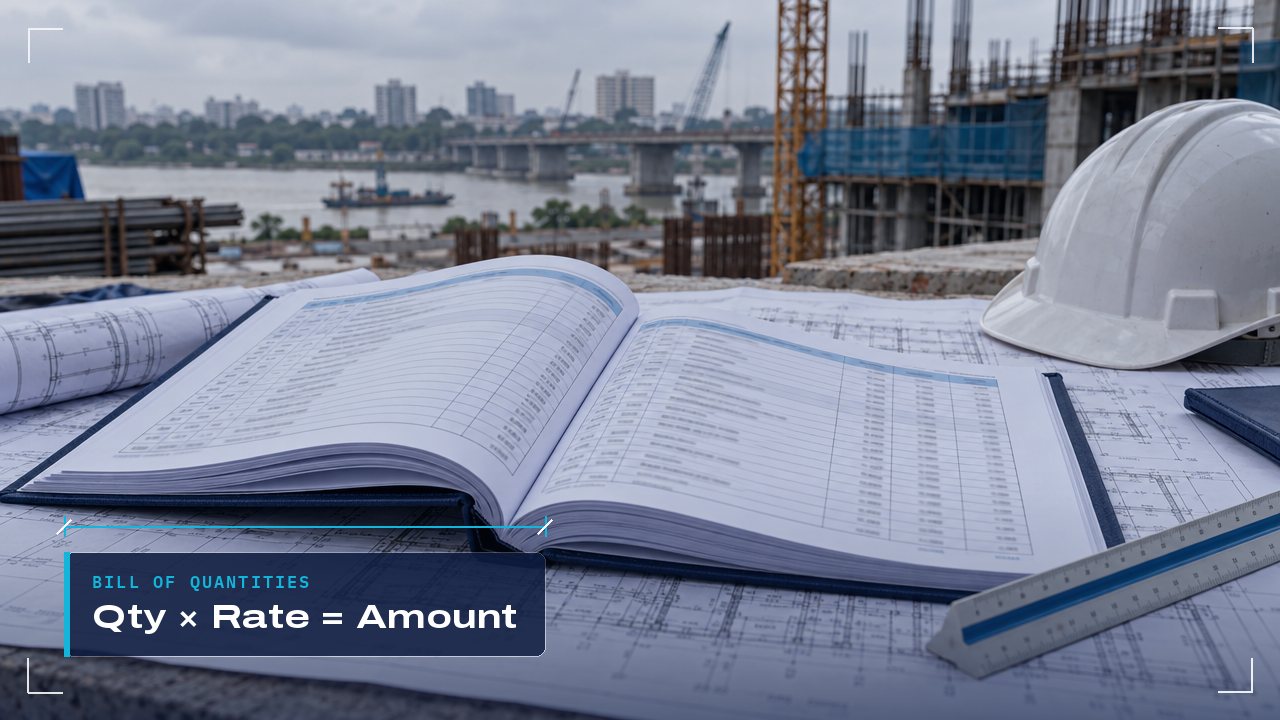
A bill of quantities (BOQ) is a list of every item of work in a project, each with a unit and a measured quantity, so that the work can be priced line by line. With a rate beside each line it becomes the estimate, then the tender, and later the basis of every bill the contractor submits.
What each line of a BOQ contains
A BOQ line has six parts, and each one answers a question.
| Column | Question it answers | Example |
|---|---|---|
| Item number | Which standard item is this? | 07.1.1 |
| Description | What exactly is to be done, to what specification? | RCC in footings, 1:2:4, stone chips |
| Unit | How is it measured? | cum |
| Quantity | How much of it is there? | 42.50 |
| Rate | What does one unit cost? | Tk per cum |
| Amount | Quantity × rate | Tk |
On public work the item number is the number in the PWD Schedule of Rates, which fixes the description, the unit and the rate together. On private work the numbering is your own, but the discipline is the same: one line, one clearly described piece of work.
One list, used five times
The work is read from the drawings.
How the lines are grouped
Lines are grouped under headings that follow the order of construction: earthwork, foundation, reinforced concrete, brickwork, plaster, flooring, doors and windows, painting, sanitary and plumbing, electrical, external works. Each group has a sub-total, and the sub-totals form the abstract of cost, the one page an owner actually reads. The full sequence is in the order of items in a building BOQ.
Where the quantities come from
Every quantity is the result of a measurement, and the working is kept on a measurement sheet: number × length × breadth × height, line by line, with deductions for openings.
A small example. Six column footings, each 5 ft × 5 ft × 1.5 ft:
- 6 × 5 × 5 × 1.5 = 225 cft of concrete in footings
That one line of working is what lets a checker, an auditor or you in six months confirm where 225 came from. A BOQ without its measurement sheet is a list of numbers nobody can defend.
Where the rates come from
A rate is either taken from a schedule or built by a rate analysis: the materials, labour and equipment for one unit of the item, plus overhead and profit. Public estimates use the Schedule of Rates in force for the project's zone. Contractors and private owners build rates from market prices. The difference between the two is explained in PWD rate or market rate.
Who prepares it, and who uses it
The client's engineer or consultant prepares the BOQ and the official estimate. Contractors price the same quantities to tender, so their offers can be compared. The site engineer measures completed work against it for every running bill, and the final bill is the BOQ measured again as built.
This page is about preparing a BOQ. If you have received one and need to check it, Prime Base Engineering's guide on how to read a BOQ lists what to check and the red flags.
BOQ, estimate, quotation, abstract
These four are often used loosely. The BOQ is the measured list. The estimate is the BOQ priced by the person paying. The quotation is the BOQ priced by the person offering to build. The abstract is the summary by section. This article sets them side by side.
Mistakes that cost money
- Items missing between trades. Damp-proof course, curing, scaffolding, soil disposal and testing belong to nobody unless the BOQ names them.
- Double counting. The concrete of a beam measured through the column, and the column measured through the beam.
- Wrong zone or old edition. The item is right and the rate is not.
- Reinforcement without laps and chairs. The steel quantity is then several percent short.
- Openings not deducted from brickwork, or deducted from plaster on one face only.
- Units mixed. Feet on the drawing, metres in the rate.
A small bill, priced from end to end
Take the six footings of 5 ft × 5 ft × 1.5 ft from the example above and add the work under them: a pit 6.5 ft square and 5 ft deep for each, 3 inches of sand, brick flat soling and 3 inches of lean concrete. The rates are examples, there to show the arithmetic.
| Item | Measurement | Quantity | Example rate (Tk) | Amount (Tk) |
|---|---|---|---|---|
| Earthwork in excavation | 6 × 6.5 × 6.5 × 5 | 1,267.5 cft | 12 | 15,210 |
| Sand filling | 6 × 6.5 × 6.5 × 0.25 | 63.38 cft | 45 | 2,852 |
| Brick flat soling | 6 × 6.5 × 6.5 | 253.5 sft | 60 | 15,210 |
| Lean concrete 1:3:6 | 6 × 6.5 × 6.5 × 0.25 | 63.38 cft | 250 | 15,845 |
| RCC in footings | 6 × 5 × 5 × 1.5 | 225 cft | 320 | 72,000 |
| Sub-total, foundation | 1,21,117 |
Five lines, each with its working, and one sub-total. The abstract of cost for this job would show a single line: Foundation, Tk 1,21,117. Reinforcement and formwork would be the next two items. They are left out here to keep the table short, and in a real bill leaving them out is exactly the mistake described above.
The units a BOQ uses
The unit is part of the item. Change the unit and you have changed what is being bought.
| Work | Usual unit |
|---|---|
| Earthwork, sand filling, concrete | cum or cft |
| Reinforcement | kg or metric ton |
| 250 mm (10 inch) brickwork | cum or cft |
| 125 mm (5 inch) brickwork | sqm or sft |
| Plaster, painting, tiles, soling, formwork | sqm or sft |
| Skirting, pipes, railings, drains | m or rft |
| Doors, fittings, fixtures | number |
| Site facilities, mobilisation | lump sum |
Thin work is measured by area and thick work by volume. That is why a 5 inch wall and a 10 inch wall are different items with different units, and why their rates cannot be compared directly.
How the bill is used after the contract is signed
The BOQ does not retire once the price is agreed. It becomes the ruler for every payment.
Suppose the contract holds the 225 cft of footing concrete at the example rate of Tk 320.
- First running bill. Four of the six footings are cast: 4 × 5 × 5 × 1.5 = 150 cft. The bill claims 150 × 320 = Tk 48,000.
- Second running bill. All six are cast. The bill states 225 cft to date, less the 150 cft paid before, and claims the remaining 75 × 320 = Tk 24,000.
- A change. The engineer deepens two footings by 6 inches: 2 × 5 × 5 × 0.5 = 25 cft more. Because the item and its rate already exist, the extra is paid at the same Tk 320, as 25 × 320 = Tk 8,000, and nobody has to negotiate.
This is the practical value of a good BOQ. When the work changes, there is already an agreed price for it.
Questions people ask
Who pays if the real quantity is more than the BOQ says? On an item-rate contract the work is measured as built and paid at the BOQ rate, so the client pays for the extra. On a lump-sum contract the contractor carries that risk, unless the drawings changed.
Does a small house need a BOQ? Yes, if you want to compare contractors. Two quotations can only be compared when both price the same list of work.
Is a BOQ the same as an estimate? No. The BOQ is the measured list. It becomes an estimate when rates are written beside it. See BOQ, estimate and quotation.
Doing it in Estimatrix
In Estimatrix the measurement sheet, the BOQ, the rate analysis, the material requisition and the budget are one linked project. Enter the footings above once and the quantity, the amount, the cement to buy and the foundation budget are all filled in, and they change together when the drawing changes. Create a BOQ online; it is free to start.
#boq#basics#quantity surveying
Related articles
Construction cost per square foot in Bangladesh (2026): rates, adjustments and checks
What a building costs per square foot in Bangladesh in 2026 for apartments, offices, factories, hospitals and steel sheds, what moves the figure, and how to use it to check a BOQ.
28 Oct 2026 · 6 min readRead

PWD Schedule of Rates explained: editions, zones and how to use them
What the PWD Schedule of Rates is, how its four schedules, four zones and editions work, what a schedule rate includes, and how to read an item correctly.
27 Oct 2026 · 6 min readRead
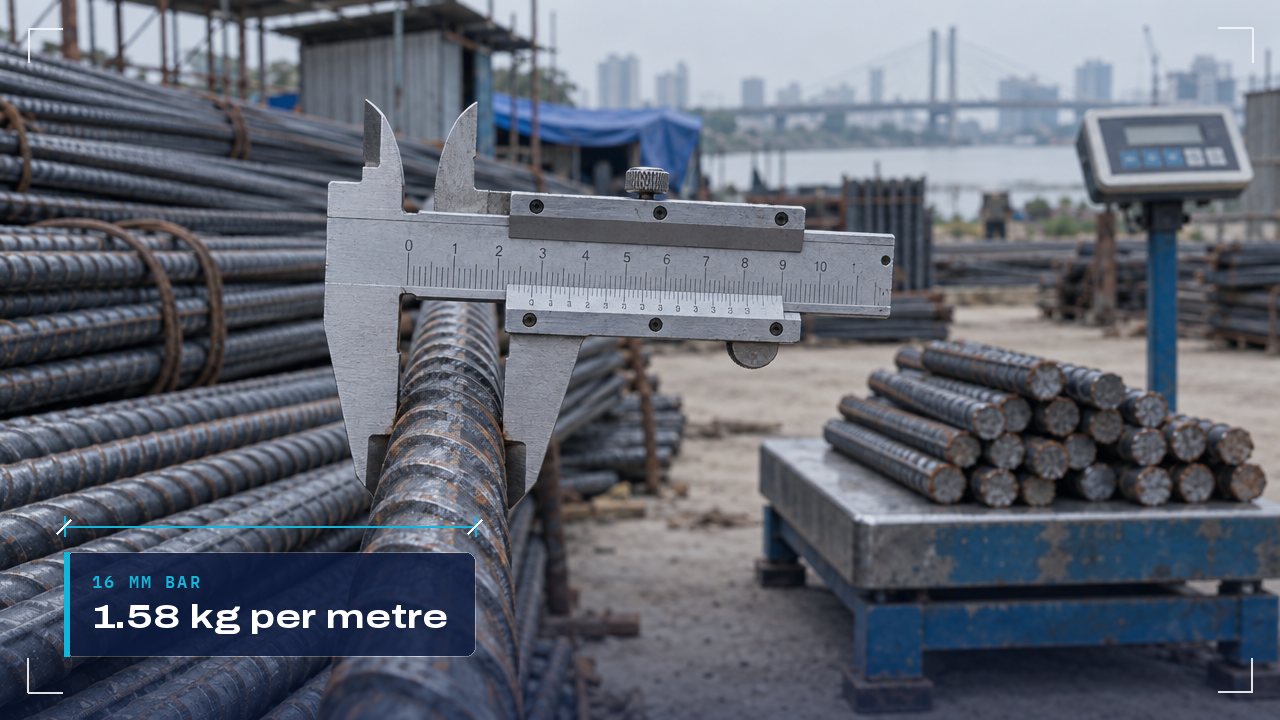
Rebar weight calculation: the D² ÷ 162 rule, with a table in kg per metre and per foot
Where the D² ÷ 162 rule comes from, the unit weight of every common bar in kg per metre and per foot, a worked example and the mistakes that put a steel estimate wrong.
23 Oct 2026 · 6 min readRead