
Engineering articlesBrickwork estimating: number of bricks, mortar, cement and sand
How many bricks, how much cement and how much sand a wall needs: the standard brick, bricks per cubic foot and cubic metre, mortar for 1:4 and 1:6, deductions for openings and a worked example.
By Muhammad Sarowar Hossain, Founder & CEOPublished 17 October 2026Updated 24 November 20267 min read
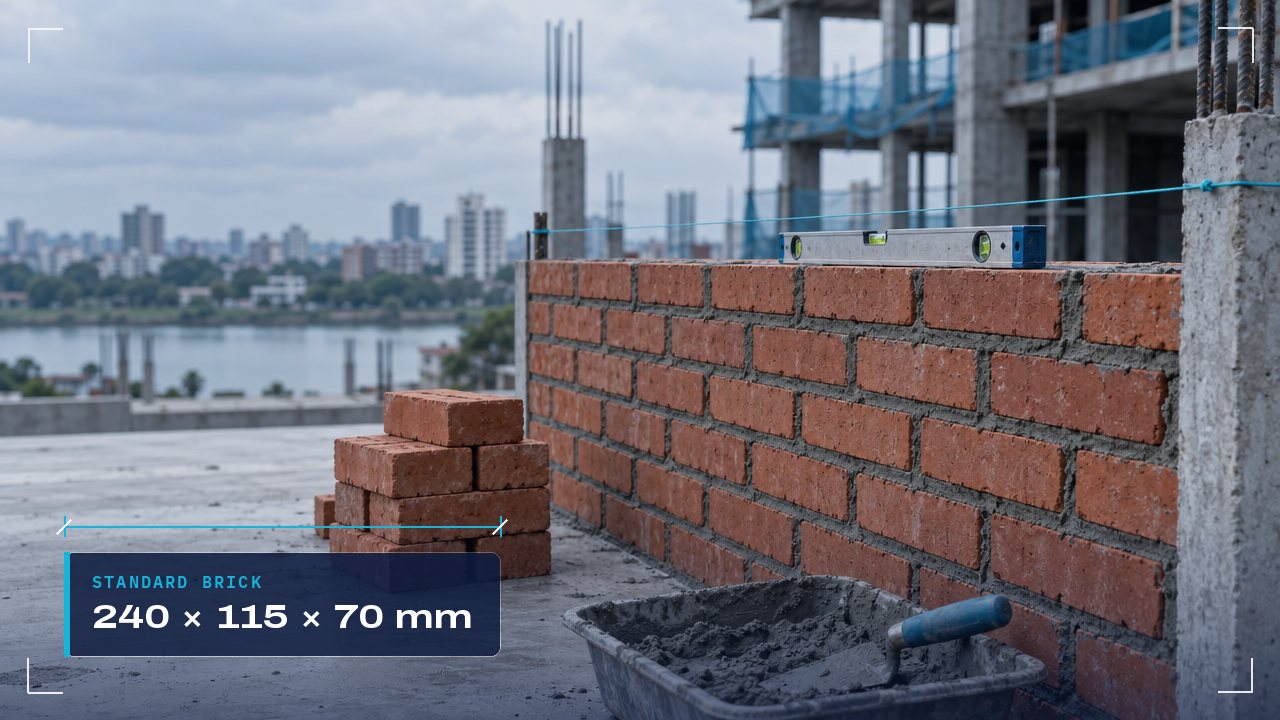
To estimate brickwork you need three figures: the net volume of the wall, the number of bricks in a unit of that volume, and the mortar that fills the rest. Most mistakes come from the first one, because doors, windows, lintels and columns are left inside the wall.
The standard brick
A first-class brick in Bangladesh measures about 9½" × 4½" × 2¾", which is 240 × 115 × 70 mm. Bricks are laid with a mortar joint of about 10 mm (⅜"), so each brick takes up a little more room than its own size: about 10" × 5" × 3" with its share of the joints. That larger size is called the nominal size, and it is the one to count with.
Local bricks vary. Measure ten from your supplier before a large order, because a brick that is 5 mm shorter changes the count on a whole building.
Bricks and mortar in a wall
1,150
11.5 bricks per cft, before wastage.
Bricks per cubic foot and per cubic metre
- One nominal brick = 10 × 5 × 3 = 150 cubic inches
- One cubic foot = 1,728 cubic inches, so 11.5 bricks per cft
- One cubic metre = 35.31 cft, so about 400 to 410 bricks per cum
For a 5 inch (half-brick) wall it is easier to count by area: about 4.8 bricks per sft, or about 50 per sqm.
Add 3 to 5% for bricks broken in carrying and cutting. On upper floors, and where many bricks are cut around openings, use the higher figure.
Mortar, cement and sand
Mortar fills the joints and the frog (the hollow in the top of the brick). A practical figure is 0.30 cft of dry mortar for each cft of brickwork. Dry volume is used because cement and sand are bought dry; it is the wet volume multiplied by 1.33.
For 100 cft of brickwork, dry mortar = 30 cft.
| Mortar | Parts | Cement | Sand |
|---|---|---|---|
| 1:4 | 5 | 30 ÷ 5 = 6 cft = 4.8 bags | 24 cft |
| 1:5 | 6 | 30 ÷ 6 = 5 cft = 4.0 bags | 25 cft |
| 1:6 | 7 | 30 ÷ 7 = 4.3 cft = 3.4 bags | 25.7 cft |
One 50 kg bag of cement is 1.25 cft.
Measuring the wall
- Measure each wall along its centre line, so that corners are not counted twice.
- Multiply by the height and the thickness. A 10 inch wall is 0.833 ft thick; a 5 inch wall is 0.417 ft.
- Deduct everything that is not brick: doors, windows, lintels, and the beams and columns the wall runs into.
- Keep each deduction as its own line on the measurement sheet. A checker should be able to see what was taken out.
A worked example
A 10 inch wall, 40 ft long and 10 ft high, with two doors of 3' × 7' and three windows of 4' × 4'.
- Gross volume = 40 × 10 × 0.833 = 333.3 cft
- Doors = 2 × 3 × 7 × 0.833 = 35.0 cft
- Windows = 3 × 4 × 4 × 0.833 = 40.0 cft
- Net brickwork = 258.3 cft
- Bricks = 258.3 × 11.5 = 2,970, and with 4% breakage 3,090 bricks
- Dry mortar = 258.3 × 0.30 = 77.5 cft
- In 1:4 mortar: cement = 77.5 ÷ 5 = 15.5 cft = 12.4 bags, sand = 62 cft
Had the openings been left in, the order would have been about 860 bricks and 3.6 bags of cement too many.
Half-brick walls
A 5 inch partition wall is normally a separate item in the BOQ, measured by area in sft or sqm, because its rate per unit volume is different: there is more labour and more cutting for the same volume. Count its bricks by area, at about 4.8 per sft.
Mistakes we see often
- Openings not deducted, or deducted from the plaster but not from the brickwork.
- Columns and beams measured again inside the wall.
- The brick count taken from the actual brick size instead of the nominal size, which gives about a quarter too many.
- Wet mortar volume used to order cement and sand, which gives a quarter too little.
Quick reference for 100 sft of wall
Most questions on site are asked by wall area, not by volume. The table is for 100 sft of wall face, before breakage is added.
| Wall | Brickwork | Bricks | Dry mortar | Cement, 1:4 | Cement, 1:6 |
|---|---|---|---|---|---|
| 10 inch | 83.3 cft | about 960 | 25 cft | 4.0 bags | 2.9 bags |
| 5 inch | measured by area | about 480 | 12.5 cft | 2.0 bags | 1.4 bags |
Sand for the 10 inch wall is 20 cft in 1:4 and 21.4 cft in 1:6. For the 5 inch wall it is 10 cft and 10.7 cft.
So one square foot of 10 inch wall holds about 9.6 bricks (11.5 × 0.833), and one square foot of 5 inch wall about 4.8.
A worked example in metres
A wall 6 m long, 3 m high and 250 mm thick, with one door of 1.0 m × 2.1 m, in 1:6 mortar.
- Gross volume = 6 × 3 × 0.25 = 4.5 cum
- Door = 1.0 × 2.1 × 0.25 = 0.525 cum
- Net brickwork = 3.975 cum, which is 140.4 cft
- Bricks = 140.4 × 11.5 = 1,614, and with 4% breakage about 1,680 bricks
- Dry mortar = 140.4 × 0.30 = 42.1 cft
- Cement = 42.1 ÷ 7 = 6.0 cft = 4.8 bags
- Sand = 42.1 × 6 ÷ 7 = 36.1 cft
That is about 406 bricks per cubic metre before breakage, inside the 400 to 410 range given above.
Bricks laid with one bag of cement
A quick check on a mason's cement use: divide the bricks in 100 cft by the bags in 100 cft.
- In 1:6 mortar: 1,150 ÷ 3.4 = about 335 bricks per bag
- In 1:4 mortar: 1,150 ÷ 4.8 = about 240 bricks per bag
If a gang lays far fewer bricks per bag than this, the joints are too thick, mortar is being wasted, or cement is leaving the site.
Checks before you order
- Measure ten bricks from the supplier's stack, end to end, and divide by ten. Do the same for width and height.
- Lay one trial course of ten bricks with the joint you intend to use and measure its length. Ten nominal bricks should run 100 inches.
- Count the courses in one foot of height on an existing wall by the same mason. Four courses to the foot matches a 3 inch nominal height.
- Order bricks in whole loads and check each delivery by counting one stack and multiplying. Do not accept a count by eye.
- Deduct first, then count. Work out the net volume before any brick or bag is calculated.
Questions people ask
How many bricks are there in one cubic foot of wall? About 11.5 of nominal size, before breakage.
Are lintels deducted? Yes. A lintel is concrete, so its volume comes out of the brickwork and goes into the concrete items.
Is the plaster included in the wall thickness? No. A 10 inch wall is 10 inches of brickwork. Plaster is measured and priced as its own item; see plaster quantity calculation.
Do machine-made or hollow bricks follow the same count? Only if their size is the same. Measure the brick you will use, add the joint, and work out the count per cubic foot the same way: 1,728 divided by the nominal volume of one brick in cubic inches.
Why is my count lower on a real wall? Thick joints, columns and beams inside the wall, and openings all lower it. The count per cubic foot is for solid brickwork only.
In Estimatrix
Enter the wall on the measurement sheet and add each opening as a deduction row; deduction rows are shown in red and subtract by themselves. The material requisition then adds up the bricks, cement and sand of every brickwork item in the project. For the price side, see rate analysis of brickwork, or try the figures in the brick calculator.
- Wall area, less openings
- 18.58 sqm
- × 0.125 m thick
- 2.323 cum
- Bricks (400 per cum)
- 930 nos
- Cement, 1:5 mortar
- 3.4 bags
- Sand
- 0.58 cum (21 cft)
Brick 240 × 115 × 70 mm, 10 mm joints, dry mortar = wet × 1.33. Add breakage.
#brickwork#masonry#mortar
Related articles
What is a bill of quantities (BOQ)? A practical guide for Bangladesh
What a BOQ is, what each column means, how it is measured and priced, and the mistakes that cost money, explained with a small worked example.
30 Oct 2026 · 7 min readRead
Construction cost per square foot in Bangladesh (2026): rates, adjustments and checks
What a building costs per square foot in Bangladesh in 2026 for apartments, offices, factories, hospitals and steel sheds, what moves the figure, and how to use it to check a BOQ.
28 Oct 2026 · 6 min readRead
PWD Schedule of Rates explained: editions, zones and how to use them
What the PWD Schedule of Rates is, how its four schedules, four zones and editions work, what a schedule rate includes, and how to read an item correctly.
27 Oct 2026 · 6 min readRead