
Engineering articlesRebar weight calculation: the D² ÷ 162 rule, with a table in kg per metre and per foot
Where the D² ÷ 162 rule comes from, the unit weight of every common bar in kg per metre and per foot, a worked example and the mistakes that put a steel estimate wrong.
By Muhammad Sarowar Hossain, Founder & CEOPublished 23 October 2026Updated 24 November 20266 min read
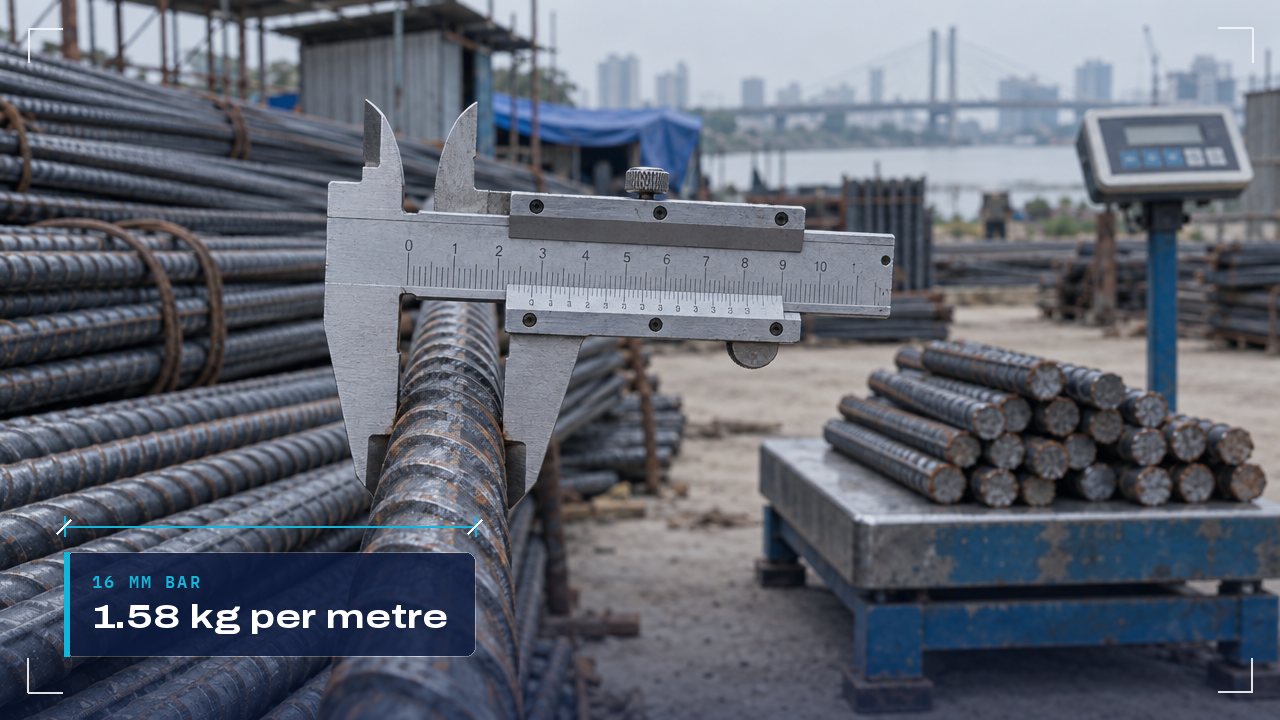
Reinforcement is measured by length and bought by weight. The link between the two is the unit weight of each bar size, and one short rule gives it: the weight of one metre of bar in kilograms is the diameter in millimetres, squared, divided by 162.
Where the rule comes from
Steel weighs about 7,850 kg per cubic metre. A round bar of diameter D mm has a cross-section of π D² ÷ 4 square millimetres, which is π D² ÷ 4 ÷ 1,000,000 square metres.
Weight of one metre = π D² ÷ 4 ÷ 1,000,000 × 7,850 = 0.006165 × D² kg
One divided by 0.006165 is 162.2, so:
weight per metre = D² ÷ 162 kg
For a length in feet, divide by 3.281 again: D² ÷ 533 kg per foot, with D still in millimetres.
D² ÷ 162 for any bar
12 × 12 = 144
The diameter in millimetres, squared.
Unit weights of the common bars
| Bar | kg per metre | kg per foot | One 12 m bar |
|---|---|---|---|
| 8 mm | 0.395 | 0.120 | 4.7 kg |
| 10 mm | 0.617 | 0.188 | 7.4 kg |
| 12 mm | 0.888 | 0.271 | 10.7 kg |
| 16 mm | 1.578 | 0.481 | 18.9 kg |
| 20 mm | 2.466 | 0.752 | 29.6 kg |
| 25 mm | 3.853 | 1.174 | 46.2 kg |
| 32 mm | 6.313 | 1.924 | 75.8 kg |
Notice how fast the weight grows: a 20 mm bar is twice the diameter of a 10 mm bar and four times its weight. One wrong diameter in a schedule moves the total far more than one wrong length.
A worked example
A slab panel needs 48 bars of 10 mm, each 4.2 m long, and 52 bars of 12 mm, each 3.6 m long.
- 10 mm: 48 × 4.2 = 201.6 m, × 0.617 = 124.4 kg
- 12 mm: 52 × 3.6 = 187.2 m, × 0.888 = 166.2 kg
- Total = 290.6 kg
That is the weight of the bars as drawn. Laps, hooks, chairs and off-cuts come on top.
From drawn length to ordered weight
- Cutting length, not member length. Hooks and laps add length, and each bend takes a little away. A bar bending schedule works this out bar by bar; see bar bending schedule: laps and hooks.
- Laps. Where one bar ends and the next begins they overlap. Either measure each lap or allow a percentage of the weight; 5 to 10% is common, depending on the detailing.
- Stock length. Bars arrive 12 m long. What is left after cutting is waste unless it is used somewhere else.
- Chairs and spacers are steel too, and binding wire is bought separately.
Mistakes we see often
- A length in feet multiplied by a weight per metre, which overstates the steel 3.28 times.
- Unit weights rounded too early. Keep three decimals until the final total.
- The diameter read from the wrong layer: top and bottom steel in a slab are often different sizes.
- Stirrups counted without their hooks.
Rolled weight is not exact
A real bar is allowed to differ a little from its theoretical weight, within the tolerance of the standard it is made to (BDS ISO 6935-2 or ASTM A615). An estimate uses the theoretical weight. When you buy, weigh a sample from each delivery.
Bars that are not in the table
The rule works for any diameter. These sizes also appear on drawings; the weights are worked out the same way, as 0.006165 × D².
| Bar | kg per metre | kg per foot |
|---|---|---|
| 6 mm | 0.222 | 0.068 |
| 22 mm | 2.984 | 0.909 |
| 28 mm | 4.833 | 1.473 |
| 40 mm | 9.864 | 3.007 |
How many 12 m bars make a tonne
Steel is priced by the tonne and delivered as bars, so it helps to know how the two relate. Divide 1,000 kg by the weight of one 12 m bar.
| Bar | One 12 m bar | Bars in a tonne |
|---|---|---|
| 8 mm | 4.7 kg | about 211 |
| 10 mm | 7.4 kg | about 135 |
| 12 mm | 10.7 kg | about 94 |
| 16 mm | 18.9 kg | about 53 |
| 20 mm | 29.6 kg | about 34 |
| 25 mm | 46.2 kg | about 22 |
| 32 mm | 75.8 kg | about 13 |
Use the table to check a delivery. If a lorry is said to carry five tonnes of 16 mm bar, it should hold about 265 bars. Count the bundles before you sign.
A worked example in feet
A beam has six bars of 20 mm, each 22 ft long.
- Total length = 6 × 22 = 132 ft
- Weight = 132 × 0.752 = 99.3 kg
Do not mix the two columns of the table. The same 132 ft multiplied by the weight per metre, 2.466, gives 325.5 kg, which is 3.28 times too much.
From weight to money
Rod is quoted per tonne. Suppose the price is Tk 90,000 a tonne, which is Tk 90 a kg. That price is an example; take the day's price from your supplier or from the market price page.
For the slab panel in the worked example above:
- Weight as drawn = 290.6 kg
- Cost = 290.6 × 90 = Tk 26,154
Laps, off-cuts and binding wire come on top, and so does the labour for cutting, bending and fixing, which is priced per kilogram or per tonne of steel fixed.
Questions people ask
Why 162 and not 162.2? The exact figure is 162.2. Using 162 changes the result by about one part in a thousand, far less than the rolling tolerance of the bar. Printed tables use the exact figure, which is why 12 mm appears as 0.888 in a table and as 0.889 from the short rule.
Does the grade of steel change the weight? No. A 500W bar and a 60 grade bar of the same diameter weigh the same per metre. The grade changes the strength, not the density.
Is the weight the same for plain and deformed bars? For estimating, yes. The nominal diameter of a deformed bar is defined so that its weight per metre matches a plain round bar of that diameter.
Can I use the rule for a square or flat bar? No. The rule comes from the area of a circle. For any other section, multiply its cross-section area in square metres by 7,850 kg per cubic metre.
How do I find the diameter of a bar on site? Read the mark rolled into the bar, or weigh a measured length. One metre of bar that weighs about 1.58 kg is a 16 mm bar.
In Estimatrix
The rebar take-off applies these unit weights by itself and shows the multiplier beside each diameter; see rebar take-off in Estimatrix. To check one figure quickly, use the rebar weight calculator.
16² ÷ 162 = 1.580 kg per metre
× 12 m × 10 bars
189.6 kg (0.190 tonne)
Add laps, hooks and chairs as your drawing requires.
#rebar#formula#steel
Related articles
What is a bill of quantities (BOQ)? A practical guide for Bangladesh
What a BOQ is, what each column means, how it is measured and priced, and the mistakes that cost money, explained with a small worked example.
30 Oct 2026 · 7 min readRead
Construction cost per square foot in Bangladesh (2026): rates, adjustments and checks
What a building costs per square foot in Bangladesh in 2026 for apartments, offices, factories, hospitals and steel sheds, what moves the figure, and how to use it to check a BOQ.
28 Oct 2026 · 6 min readRead

PWD Schedule of Rates explained: editions, zones and how to use them
What the PWD Schedule of Rates is, how its four schedules, four zones and editions work, what a schedule rate includes, and how to read an item correctly.
27 Oct 2026 · 6 min readRead