
Estimatrix guidesRebar take-off in Estimatrix: bar sizes, unit weights and lapping allowance
Reinforcement items open in their own take-off: bars × diameter × length gives kilograms, with the unit weight shown, a lapping and wastage percentage and a summary by diameter.
By Muhammad Sarowar Hossain, Founder & CEOPublished 28 October 2026Updated 24 November 20266 min read
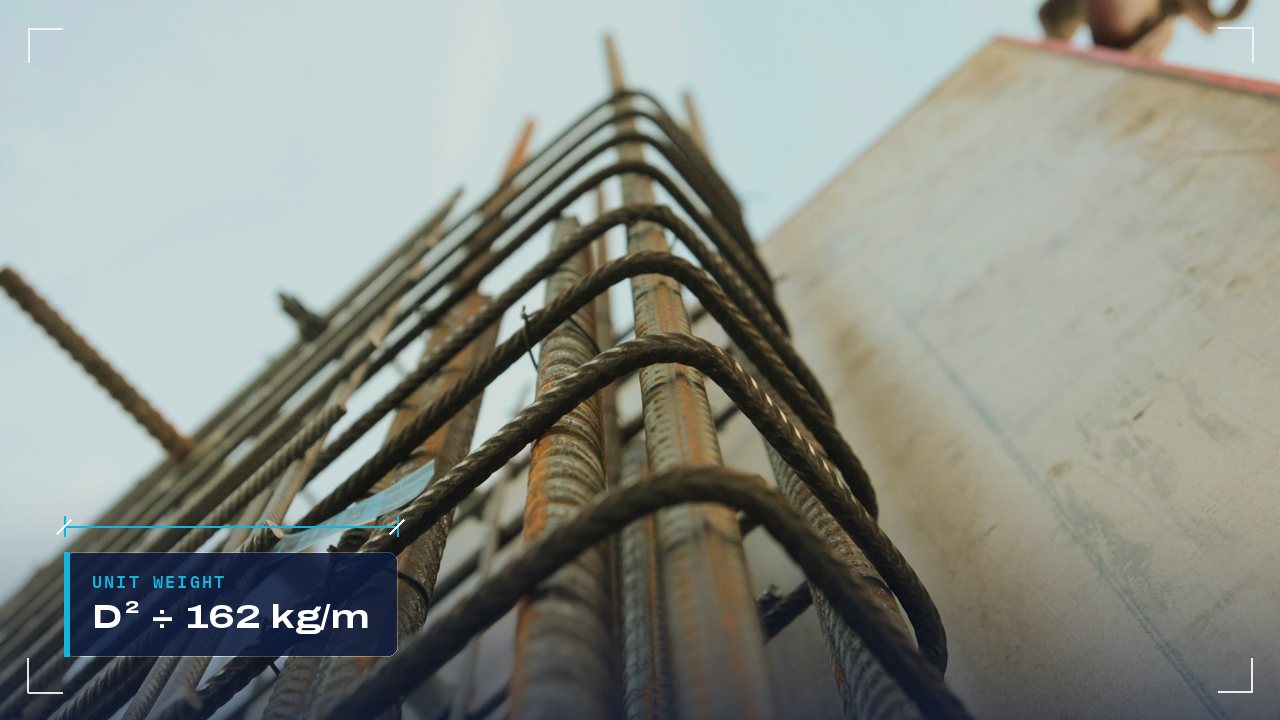
Reinforcement is usually the largest single cost in an RCC building, and it is measured in kilograms, not in cubic metres. A length that is one foot wrong on a bar that repeats 400 times is a tonne of steel.
Estimatrix recognises reinforcement items and gives them their own take-off sheet, where the weight is worked out from the number of bars, the diameter and the length.
When the rebar layout appears
Any item whose unit is kg or MT and whose description mentions reinforcement, deformed bar, M.S. rod, re-bar or a steel grade (500W, Grade 60, 72.5 and so on) opens in the rebar layout, whether it came from the PWD SoR, a custom item or your library. You can force it with Sheet layout → Rebar.
4 bars of 16 mm × 6.5 m × 12 beams
312 m
4 × 6.5 × 12 = 312 m.
The columns
| Column | Meaning |
|---|---|
| Nos (bars) | number of bars of that mark |
| Rebar dia (mm) | 8, 10, 12, 16, 20, 25 or 32 mm |
| Length | length of one bar (m or ft) |
| × Members / layers | repetition, for example the number of identical beams |
| Total length | Nos × Length × Members |
| Quantity | Total length × unit weight |
Next to the diameter, the sheet shows the unit weight applied, for example 0.270 kg/ft for 12 mm, so a checker can verify the multiplier.
Unit weights used
Estimatrix uses the standard table values (d²/162.2 kg/m, rounded as printed):
| Dia (mm) | kg/m | kg/ft |
|---|---|---|
| 8 | 0.395 | 0.120 |
| 10 | 0.617 | 0.188 |
| 12 | 0.888 | 0.270 |
| 16 | 1.578 | 0.481 |
| 20 | 2.466 | 0.751 |
| 25 | 3.853 | 1.174 |
| 32 | 6.313 | 1.923 |
Why d²/162? See rebar weight calculation explained.
Two worked examples
In feet. 12 mm bars: Nos = 2, Length = 3 ft, Members = 5.
- Total length = 2 × 3 × 5 = 30 rft
- Weight = 30 × 0.270 = 8.10 kg
In metres, with an allowance. Four 16 mm bottom bars, 6.5 m long, in each of 12 identical beams.
- Total length = 4 × 6.5 × 12 = 312 m
- Weight = 312 × 1.578 = 492.3 kg
- With a lapping and wastage allowance of 7.5% = 529.3 kg
Lapping and wastage
Bars are sold in 12 m (39.37 ft) lengths, so long runs need laps, and cutting leaves off-cuts. Set Lapping / wastage % on the item, with quick buttons for 0, 5, 7.5 and 10%, and it is added to the take-off weight. The total row states the allowance used.
A percentage is a fair allowance at estimate stage. For lap lengths, hooks and bend deductions bar by bar, use the bar bending schedule and set the item's quantity source to BBS.
Rebar summary by diameter
Below the sheet, the rebar summary lists kg and MT per diameter for this item and for all rebar take-offs in the project, which is what procurement needs to order steel. The Material requisition combines it with the bar bending schedule.
Kilograms or metric tons
If the unit of the BOQ item is MT, the take-off weight is divided by 1,000; the summary always shows both.
A slab panel, from spacing to kilograms
Bars in a slab are given by spacing, not by number, so the first step is to count them. The number of bars is the distance they are spread over, divided by the spacing, rounded up, plus one.
A slab panel 4.0 m × 5.0 m has 10 mm bars at 150 mm centres both ways.
- Bars spanning 4.0 m, spread over 5.0 m: 5,000 ÷ 150 = 33.3, so 34 spaces and 35 bars
- Bars spanning 5.0 m, spread over 4.0 m: 4,000 ÷ 150 = 26.7, so 27 spaces and 28 bars
| Row | Nos | Dia | Length | Total length |
|---|---|---|---|---|
| Short bars | 35 | 10 | 4.0 | 140 m |
| Long bars | 28 | 10 | 5.0 | 140 m |
Weight = 280 m × 0.617 kg/m = 172.8 kg. With a lapping and wastage allowance of 5% it is 181.4 kg. Cover, bends at the supports and extra top bars are left out here to keep the count clear; in a real take-off they come from the drawing.
From take-off weight to bars to buy
The take-off gives the weight of the bars as drawn. The shop sells 12 m bars. The difference is the off-cut.
In the slab above, a 12 m bar gives three pieces of 4.0 m with nothing left, so the 35 short bars need 12 stock bars. A 12 m bar gives two pieces of 5.0 m and leaves 2.0 m, so the 28 long bars need 14 stock bars.
- Stock bars to buy = 12 + 14 = 26 bars
- Weight to buy = 26 × 7.4 kg = 192.4 kg
That is about 11% more than the 172.8 kg drawn, and more than double the 5% allowed. The 2.0 m pieces are the reason. If they can be used elsewhere, as chairs or short bars in another member, the loss falls. This is why a percentage is good enough for an estimate and a cutting list is needed for an order.
Percentage or bar bending schedule?
| Stage | Use | Why |
|---|---|---|
| First budget, no bar schedule yet | The take-off with a percentage | Fast, and close enough to decide |
| Tender on full drawings | The take-off, bar by bar from the drawing, with a percentage for laps | Every bar is counted, laps are allowed for |
| Ordering and cutting on site | The bar bending schedule | Cut lengths, laps, hooks and 12 m bars are worked out exactly |
In Estimatrix the two feed the same BOQ item. Set the item's quantity source to the take-off or to the BBS, and the reinforcement quantity in the bill follows the one you chose.
Site practice that changes the quantity
- Laps are placed where the drawing allows them. A lap moved to the wrong place is cut out and done again, and both bars are paid for.
- Off-cuts need a home. Sort them by diameter and length as they are made. An unsorted heap is scrap.
- Count stock bars on delivery, by diameter. A missing bundle of 10 mm bars is found on the day or never.
- Rolled weight differs a little from table weight. Weigh a sample length when the consignment arrives if the order is large.
Questions people ask
Does the grade of steel change the weight? No. A 16 mm bar weighs 1.578 kg per metre in any grade. The grade changes the price and the design, not the weight.
Should stirrups go in the take-off? Yes, as their own rows: the number of stirrups, the diameter and the cutting length of one. See the stirrup worked out in the bar bending schedule article.
The BOQ item is in MT. Do I enter tonnes? No. Enter bars, diameters and lengths as usual. The weight is divided by 1,000 for you.
Which allowance should I choose? One you can defend from your own jobs. Compare the steel bought with the steel drawn on a finished project, and use that figure next time.
Mistakes we see often
- A length in feet entered in a metric project, so the weight is more than three times too high. The unit weight shown beside the diameter is the quickest check.
- Stirrups and ties left out because they are small. In a beam they are a real share of the steel.
- The Members column forgotten, so twelve beams are counted as one.
- A lapping allowance added in the take-off and again in the rate.
16² ÷ 162 = 1.580 kg per metre
× 12 m × 10 bars
189.6 kg (0.190 tonne)
Add laps, hooks and chairs as your drawing requires.
#rebar#reinforcement#take-off
Related articles
How to create a BOQ online with Estimatrix, step by step
From a blank project to a priced, tender-ready bill of quantities on the PWD Schedule of Rates: what to prepare, set-up, items, measurement, rates and export.
30 Oct 2026 · 7 min readRead
Measurement sheets: Enter-key entry, formulas, deductions and extra columns
Fast keyboard take-off in Estimatrix: Enter-key navigation, formulas inside cells, columns that follow the unit, deductions, multiplier columns and a worked example.
29 Oct 2026 · 7 min readRead

Rate analysis on the PWD Schedule of Rates: how Estimatrix builds it
Every SoR item arrives with a rate analysis: material quantities from the specification, PWD basic rates for your zone, market prices alongside and a balancing line that keeps the published rate.
26 Oct 2026 · 6 min readRead