
Engineering articlesConcrete material quantities: the 1.54 dry-volume factor and bags of cement
How to find the cement, sand and stone chips for 1:2:4, 1:1.5:3 and 1:3:6 concrete, why dry materials are 1.54 times the finished volume, and how to turn cement into bags.
By Muhammad Sarowar Hossain, Founder & CEOPublished 19 October 2026Updated 24 November 20266 min read
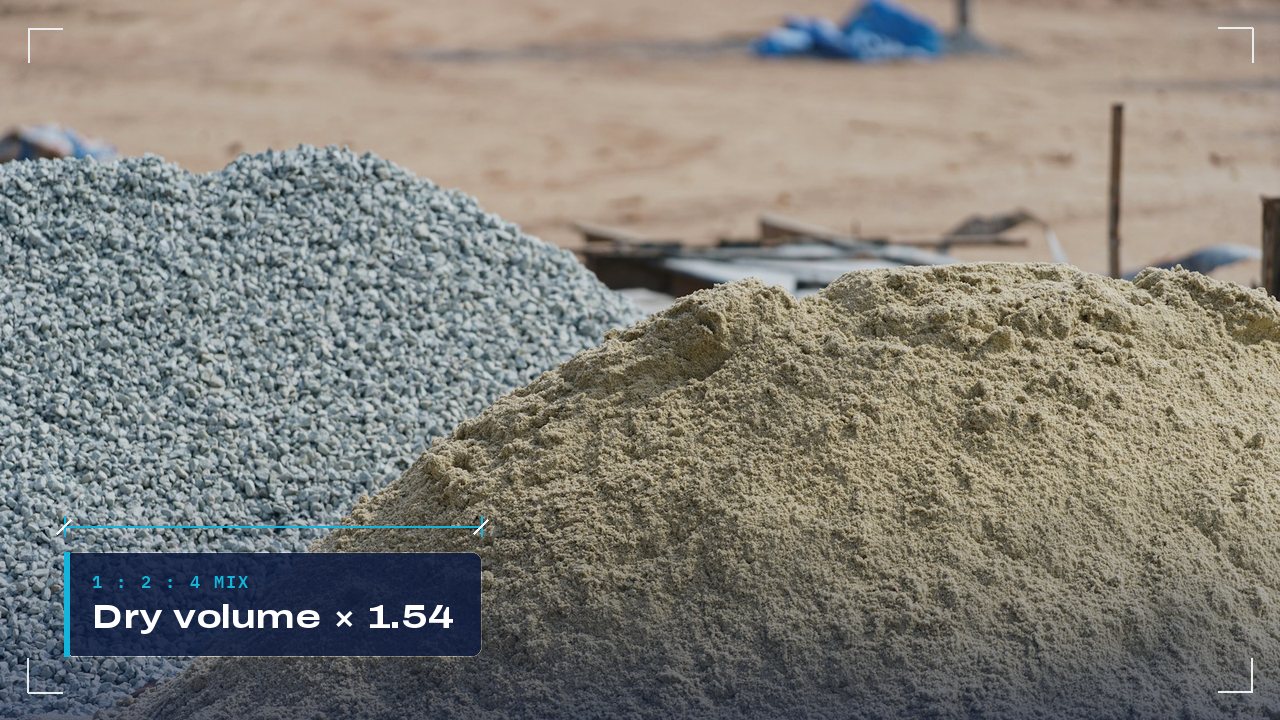
Nominal-mix concrete is described by a ratio of volumes, cement : sand : stone chips, such as 1:2:4. To order materials you need one more number: how much dry material makes one unit of finished concrete. That number is 1.54.
Why 1.54?
Loose dry sand and chips are full of air spaces. When water is added and the concrete is compacted, the fine grains settle into the spaces between the coarse ones and the volume shrinks. Experience on site shows that the dry materials need to be about 52 to 57% more than the finished volume. The usual working figure is 1.54.
Estimatrix uses 1.54 unless you change it for a project under Tools, in the dry-to-wet factors.
Materials for 1 cum of concrete
1.54 cum
Wet volume × 1.54.
The method
- Dry volume = finished (wet) volume × 1.54
- Add the parts of the ratio: for 1:2:4 that is 1 + 2 + 4 = 7
- Cement = dry volume × 1 ÷ 7, sand = dry volume × 2 ÷ 7, chips = dry volume × 4 ÷ 7
Cement in bags
A 50 kg bag of cement fills about 1.25 cubic feet, which is 0.0347 cubic metre; the bulk density of cement is close to 1,440 kg per cubic metre. Divide the cement volume by the volume of one bag.
A worked example: 1 cum of 1:2:4
- Dry volume = 1.54 cum
- Cement = 1.54 ÷ 7 = 0.220 cum = 6.3 bags (about 317 kg)
- Sand = 0.440 cum
- Stone chips = 0.880 cum
A worked example: 100 cft of 1:1.5:3
- Dry volume = 154 cft; parts = 1 + 1.5 + 3 = 5.5
- Cement = 154 ÷ 5.5 = 28.0 cft = 22.4 bags
- Sand = 42.0 cft
- Stone chips = 84.0 cft
Quick reference for 1 cum of finished concrete
| Mix | Cement | Sand | Stone chips |
|---|---|---|---|
| 1:3:6 (lean concrete) | 4.4 bags | 0.46 cum | 0.92 cum |
| 1:2:4 | 6.3 bags | 0.44 cum | 0.88 cum |
| 1:1.5:3 | 8.1 bags | 0.42 cum | 0.84 cum |
Allow for waste
Some material is always lost in carrying, stacking and mixing. A common allowance is 1.5 to 2.5% on cement and 2.5 to 5% on sand and chips, more on a cramped site. Write the allowance down as its own line, so a checker can see it.
Designed mixes are different
Concrete specified by strength, such as 25 or 40 MPa, is not batched by a volume ratio. Its proportions come from a mix design, usually by weight. For such concrete take the cement content per cubic metre from the mix design, not from the method above.
Mortar uses a smaller factor
Mortar has no coarse aggregate, and sand alone has fewer spaces to fill, so its factor is about 1.33. See brickwork estimating and plaster quantity calculation.
Mistakes we see often
- Finished volume used to order materials, which leaves the site a third short.
- The 1.54 factor applied to a designed mix.
- Damp sand measured by volume. Sand swells when damp, so a box of damp sand holds less sand than a box of dry sand.
- Brick chips and stone chips treated as the same item. Their rates and their concrete strengths are different.
Quick reference for 100 cft of finished concrete
Sand and chips are sold by the cubic foot, so the same table in feet is the one a site uses most. Dry volume is 154 cft in every row.
| Mix | Parts | Cement | Sand | Stone chips |
|---|---|---|---|---|
| 1:3:6 | 10 | 15.4 cft = 12.3 bags | 46.2 cft | 92.4 cft |
| 1:2:4 | 7 | 22.0 cft = 17.6 bags | 44.0 cft | 88.0 cft |
| 1:1.5:3 | 5.5 | 28.0 cft = 22.4 bags | 42.0 cft | 84.0 cft |
Notice that the sand and the chips hardly change from one mix to the next. A richer mix is almost entirely a matter of more cement.
A worked example: a roof slab in feet
A slab 30 ft × 40 ft and 5 inches thick, in 1:2:4.
- Volume = 30 × 40 × 5 ÷ 12 = 500 cft (14.2 cum)
- Dry volume = 500 × 1.54 = 770 cft
- Cement = 770 ÷ 7 = 110 cft = 88 bags
- Sand = 770 × 2 ÷ 7 = 220 cft
- Stone chips = 770 × 4 ÷ 7 = 440 cft
Measure the slab without deducting the reinforcement, and do not add the beams twice: the part of a beam inside the slab thickness belongs to the slab.
A worked example: columns in metres
Twelve columns of 300 × 450 mm, 3.0 m high, in 1:1.5:3.
- Volume = 12 × 0.30 × 0.45 × 3.0 = 4.86 cum
- Dry volume = 4.86 × 1.54 = 7.484 cum
- Cement = 7.484 ÷ 5.5 = 1.361 cum = 39.2 bags, so order 40
- Sand = 1.361 × 1.5 = 2.04 cum
- Stone chips = 1.361 × 3 = 4.08 cum
Cement is ordered in whole bags. Round up after the waste allowance has been added, not before.
From bags to kilograms
Some specifications state cement in kilograms per cubic metre. One bag is 50 kg, so 6.3 bags in a cubic metre of 1:2:4 is about 315 kg, and 8.1 bags in 1:1.5:3 is about 405 kg. Treat these as what the volume method gives, not as a mix design.
Checks on site
- Count the bags used against the volume poured. A 500 cft slab in 1:2:4 should use about 88 bags. If 70 were used, the mix was lean or the volume was less than measured.
- Use one measuring box for everything. A box that holds 1.25 cft matches one bag of cement, so a 1:2:4 batch is one bag, two boxes of sand and four boxes of chips.
Batching, slump, test cylinders and curing, the checks that decide whether the concrete reaches its strength, are in Prime Base Engineering's concrete quality control checklist.
Questions people ask
Does the 1.54 factor change with brick chips? Many offices use the same figure for both, and Estimatrix does unless you change it for a project. If your office has its own tested figure, use that one everywhere and write it on the estimate.
Do I deduct the volume of the steel? No. Reinforcement is not deducted from the concrete volume in an estimate.
How many bags of cement are in 1 cum of 1:3:6? About 4.4. The dry volume is 1.54 cum and the parts add up to 10, so the cement is 0.154 cum, and 0.154 ÷ 0.0347 = 4.4 bags.
In Estimatrix
The rate analysis of each concrete item holds its mix, and the material requisition adds up the cement, sand and chips of every item in the project. For the price side see rate analysis of RCC concrete, or try the concrete material calculator.
Dry volume = 10 × 1.54 = 15.40 cum, shared over 7 parts
- Cement
- 63.4 bags (2.20 cum)
- Sand
- 4.40 cum (155 cft)
- Stone chips
- 8.80 cum (311 cft)
One 50 kg bag = 0.0347 cum. Add your site wastage.
#concrete#cement#material quantity
Related articles
What is a bill of quantities (BOQ)? A practical guide for Bangladesh
What a BOQ is, what each column means, how it is measured and priced, and the mistakes that cost money, explained with a small worked example.
30 Oct 2026 · 7 min readRead
Construction cost per square foot in Bangladesh (2026): rates, adjustments and checks
What a building costs per square foot in Bangladesh in 2026 for apartments, offices, factories, hospitals and steel sheds, what moves the figure, and how to use it to check a BOQ.
28 Oct 2026 · 6 min readRead

PWD Schedule of Rates explained: editions, zones and how to use them
What the PWD Schedule of Rates is, how its four schedules, four zones and editions work, what a schedule rate includes, and how to read an item correctly.
27 Oct 2026 · 6 min readRead